58.7%
organic results returned as google.com/goto
2,552 of 4,344 in the sample of October 30, 2026
99%
of results pages affected
503 of 508, 8 countries
0
wrapped results from October 15 to 21
out of 71,531 organic results, retrieved again from my account
189/189
breadcrumb host = redirect host
first Location header, lowercased, without www.; 200 random wrapped results
My own queries through the DataForSEO SERP API (Google organic), October 15–30, 2026. Method and limitations below.
I noticed it in my own tool: on October 30 at 16:34 UTC, it showed a website as “not in the top 10” for its brand name. In the list of other results, “google.com” appeared instead. Since Google began redirecting result links through google.com/goto, anyone querying results through an API has to determine which website a link leads to. Among the retrieved results from my account for October 15 to 21, I found no goto URLs; on October 30, more than half of the results had them. In the next query at 18:11 UTC, now using the domain from the breadcrumb, the same website ranked first. These were two separate queries, not a controlled comparison, but they prompted this measurement.
An example from my own data: for the query “evergrow solution” (mobile, Germany, October 30, 2026), my own website is the organic result in position 4 in this API response:
{
  "type": "organic",
  "rank_group": 4,
  "domain": "google.com",
  "url": "https://google.com/goto?url=CAESVwHrOzAV…",
  "breadcrumb": "https://evergrowsolution.de",
  "website_name": "evergrowsolution.de"
}
What was already known: timeline
| When | What |
|---|---|
| June 23, 2026 | Alex Greenland documents Google result links using google.com/goto (the earliest evidence cited by PPC Land). |
| August 26, 2026 | Google confirms their use to Barry Schwartz of Search Engine Roundtable, according to PPC Land. |
| August 27–28, 2026 | DataForSEO: 99.99% of results pages no longer contain an unresolved organic goto URL; an addendum reports target URLs for all affected elements, with rare exceptions still possible. |
| August 31, 2026 | SISTRIX newsletter (Johannes Beus, according to PPC Land): each wrapped link is resolved individually, requiring additional requests. |
| September 5, 2026 | SerpApi reports that its Google Search API returns direct target URLs again, according to PPC Land. |
| October 15–21, 2026 | My retrieved DataForSEO queries: no organic result with a goto URL among 71,531 results. |
| October 22–29, 2026 | First isolated cases, with a cluster lasting an hour around midday on October 29. |
| October 30, 2026 | 58.7% of organic results in my sample returned as google.com/goto. |
| October 30, 2026, 22:20 UTC | My own check: all 12 goto links of a fresh results page returned the waiting page (“Anfrage wird verifiziert”, HTTP 200) immediately and after 60 seconds; after 180 seconds, all 12 returned the normal redirect (302). |
| October 31, 2026, 01:25 UTC | DataForSEO support replies to my request: Google limits the resolution of goto links per results page (details below). |
| October 31, 2026, 07:08 UTC | My follow-up measurement after the reply: standard queue still 61.0% goto, live 67.7%. |
| October 31, 2026, 12:24–13:28 UTC | Comparison of five SERP APIs in eight countries: 54.8% to 84.7% of organic results without a real URL, complete for no provider (separate study). |
| October 31, 2026, 12:41 UTC | Second reply from DataForSEO support: pointed to the converter, still working on it. |
What DataForSEO says
I sent DataForSEO the measurements with task IDs on October 30. Its support team replied on October 31 at 01:25 UTC. The issue is known there. The key points, paraphrased:
- Cause at Google: Google has introduced a limit on how many goto links from a single results page can be resolved within a short time. Each link carries an identifier of its results page. Instead of the redirect, Google then returns an interstitial page with a “Continue” button that only becomes active after a delay. On a page with 18 goto links, according to DataForSEO, the first 5 to 6 resolve instantly, the 7th adds 1 second, the 8th 3 seconds, the 15th up to 40 seconds, and in some cases up to 120 seconds per link.
- No way around it: The limit applies per results page, not per IP address or query. According to DataForSEO, changing the IP, changing the query or waiting before resolving does not help, not even waiting an hour or longer.
- Effect on the SERP API: In the standard queue, DataForSEO says it now resolves all goto links, with longer execution times. With high priority and live, about 50% are resolved because of time constraints.
- Recommendation: Use the standard queue, or the free endpoint
appendix/goto_url_converter, which converts up to 100 goto URLs per request into destination URLs, including previously collected data. For all links of one results page, this can take 40 to 60 seconds.
My own check on October 30 is consistent with this: I got the waiting page from the very first link. Resolution at DataForSEO had probably already used up the limit for those results pages. I checked both recommendations myself on October 31:
| Check on October 31, 2026 | Result |
|---|---|
Converter goto_url_converter: 100 random goto URLs from the October 30 sample | Status “Ok.”, 3.1 seconds, balance unchanged. In 95 of 95 cases with a domain in the breadcrumb, the destination URL had the same domain. The other 5 (YouTube, Facebook, Reddit) got the full platform URL. |
| Converter with fresh links: 3 live queries (Germany, desktop), goto URLs converted right after | 19 of 19 resolved, all 19 domains matched the breadcrumb. 31 to 41 seconds per results page, free. So the converter also works where the throttling hits. |
| Standard queue, 07:07:55 UTC: 30 local queries in Germany and 30 queries in the US, desktop, depth 10 (same queries as on October 30) | All 60 tasks ready after about 15 seconds. 331 of 543 organic results (61.0%) still came back as google.com/goto (Germany 56.7%, US 65.9%), on all 60 results pages. |
| live/regular, 10 local queries in Germany, desktop | 67 of 99 organic results (67.7%) as google.com/goto. |
So the announced resolution in the standard queue was not yet visible in my queries on the morning of October 31. I sent DataForSEO the new measurement and asked whether the new processing is already active for all accounts. Until then, the converter is the reliable way to get the full destination URL.
Update: other SERP APIs are affected too
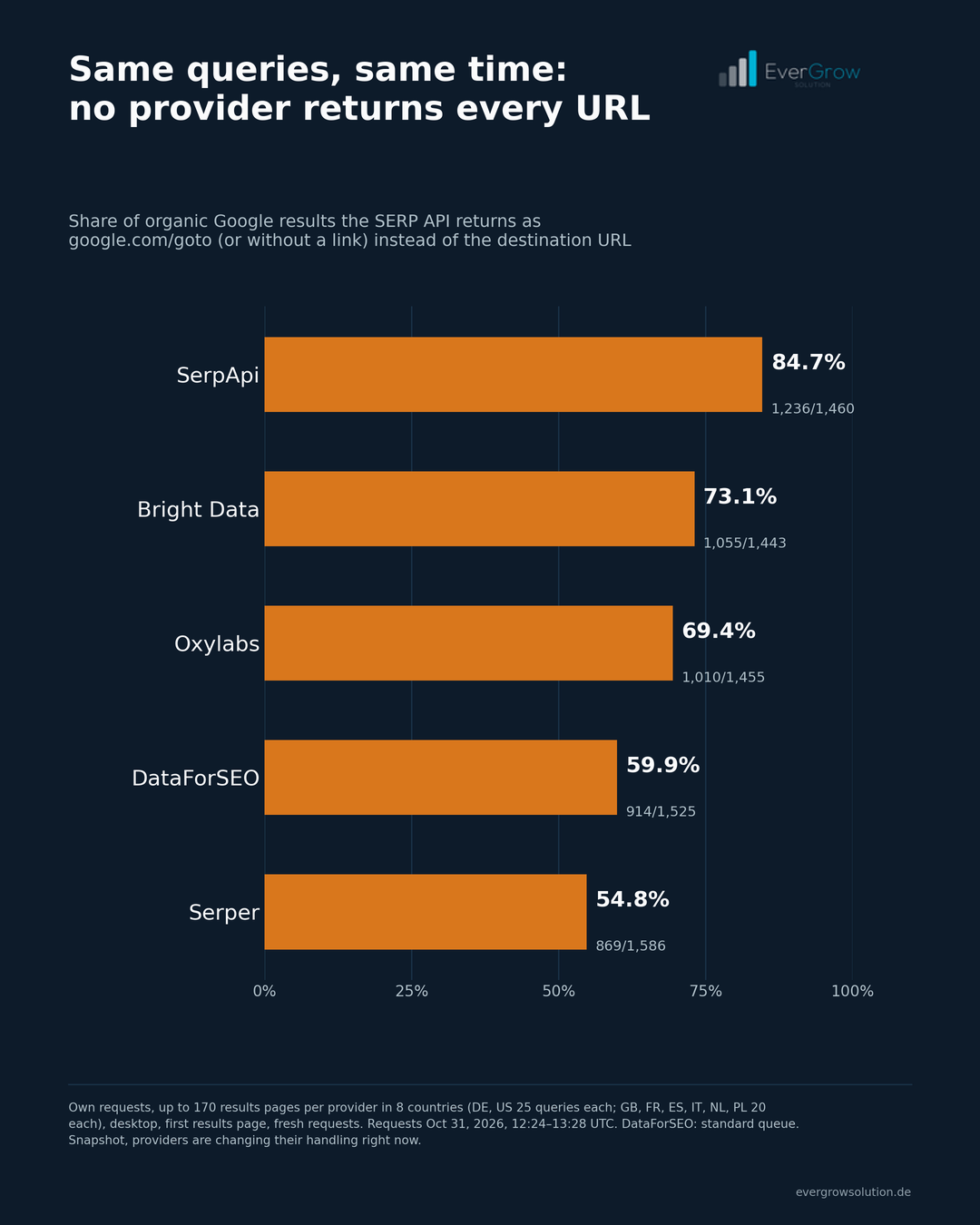
Is this just DataForSEO? On October 31, I sent the same queries at the same time to five SERP APIs: DataForSEO, SerpApi, Bright Data, Serper and Oxylabs, up to 170 results pages each in eight countries. No provider returned every result with a real URL; depending on the provider, it was missing for 54.8 to 84.7%. Every provider handles it differently, but the domain almost always stays readable. All numbers, the pattern by position and the field names per provider are in the separate study Five SERP APIs compared.
Method and limitations
- October 30 sample: 510 search queries between 18:36 and 18:38 UTC through the standard queue of the DataForSEO SERP API (Google organic, requested depth 10, all elements via task_get/advanced). Germany: after the exclusion, 149 analysed queries across five search categories (local services, purchase intent, informational questions, brands and B2B), each on desktop and mobile. Another 30 desktop queries each in the United States, United Kingdom, France, Spain, Italy, the Netherlands and Poland. One brand query is excluded from all figures in this study, leaving 508 of the 510 requested results pages for analysis. I counted all returned organic results (including 7 in position 11; positions 1 to 10 only: 2,547 of 4,337, also 58.7%).
- What I counted: organic results whose URL starts with google.com/goto?url=. All 2,552 had “google.com” in the domain field. I also counted all other link fields in the response, such as product cards or AI Overview sources (counted as occurrences, not unique links).
- Historical data: re-fetches attempted for all 9,302 Google organic queries in my account from October 15 to 29 that were originally successful (listed via id_list). 8,962 returned status “Ok.” (20000); 340 did not (mostly error 40101; on October 29, 154 of 807). 8,948 were analysed after excluding one keyword. These queries came from various measurements of my own, with different terms, countries and depths. The account balance was the same before and after retrieval.
- Additional samples: at 17:37 UTC on October 30, 11 queries via live/regular, live/advanced (each on desktop and mobile) and the queue; at 18:13 UTC, 6 queries each in five countries.
- Cross-check: 200 randomly selected wrapped results. One request each to the goto URL on www.google.com, without following the redirect. I compared the host in the first Location header with the domain in the breadcrumb (lowercased, without www.). I did not request the destination pages themselves.
- Limitations: The main measurement covers one provider, DataForSEO. I measured four more SERP APIs in a separate comparison on October 31 (Five SERP APIs compared), not rank trackers themselves. The queries were selected manually; the 58.7% applies to this mix and is not a figure for all Google searches. Results from the same results page are related, so I do not report confidence intervals. My data does not show the cause itself. DataForSEO points to a limit by Google on resolving links per results page. That is consistent with my own check (see timeline), but I cannot see inside DataForSEO’s processing. The follow-up measurement on October 31 covers 70 results pages and only shows the state at that time.
Finding 1: More than half the results, across all eight countries
2,552 of 4,344 organic results came back as google.com/goto: 58.7%. At least one such result appeared on 503 of 508 results pages.
- Country
- United States 64.9% (163 of 251)
- United Kingdom 61.6% (162 of 263)
- Germany 59.5% (1,492 of 2,506)
- France 58.4% (153 of 262)
- Italy 56.3% (152 of 270)
- Spain 55.3% (146 of 264)
- Poland 54.7% (141 of 258)
- Netherlands 53.0% (143 of 270)
The countries use different queries and languages; this is not a country comparison in the strict sense.
The smaller samples taken earlier show the same picture: Austria 51% and Switzerland 55% (6 queries each); 49 to 66% across live/regular, live/advanced and the queue (11 queries).
Finding 2: No cases through October 21, almost everywhere on October 30
| Period (UTC) | Results pages | Organic results | Of which google.com/goto |
|---|---|---|---|
| Oct 15–21 | 4,568 | 71,531 | 0 |
| Oct 22–28 | 3,727 | 63,782 | 99 (0.16%, on 8 pages) |
| Oct 29 | 653 | 12,241 | 355 (2.9%, on 27 pages) |
| Oct 30, 18:36–18:38 | 508 | 4,344 | 2,552 (58.7%, on 503 pages) |
October 15–29 = successfully re-fetched Google organic queries from my account (9,302 re-fetches attempted; 8,962 returned status 20000, 340 did not; 8,948 analysed after excluding one keyword); October 30 = sample. Different terms, countries and depths on each day.
On October 29, all 27 affected results pages fell between 12:19 and 13:20 UTC, out of 582 results pages in that period. On the affected pages, nearly three quarters of results were wrapped (355 of 493). I found no cases before that window (62 pages from 09:56) or afterwards (9 pages through 21:32). However, 154 of 807 queries from that day could not be successfully re-fetched. On October 30, my tool already showed “google.com” among the results of a brand query at 10:39 UTC, and in all my samples from 17:37 UTC onwards, almost every results page had wrapped results. These data cannot establish the exact start or whether there were pauses in between.
Finding 3: All devices, positions and search categories affected, with differences
- Device: desktop 55.7%, mobile 63.7% (Germany, the same 149 queries). Both devices were affected for 145 of 149 queries.
- Position: in positions 1 to 10, the share ranges from 55 to 61%, with no clear trend. The first result is affected too (290 of 508).
- Search category (Germany): purchase intent 72.0% (80 pages), local services 65.6% (60), brands 54.0% (38), B2B 52.0% (40), informational questions 48.5% (80).
Finding 4: Product cards and comparison sites too
- Element
- Comparison sites 79% (442 of 562)
- Product cards 75% (1,896 of 2,522)
- Top stories 64% (54 of 84)
- Organic results 58.7% (2,552 of 4,344)
- Short videos 57% (96 of 167)
- Sitelinks 22% (265 of 1,213)
- Images 20% (223 of 1,135)
- Videos 18% (56 of 315)
- Local pack 9% (57 of 627)
- AI Overview sources 0% (0 of 4,471)
None of the 4,471 AI Overview source entries contained a goto URL. However, 553 pointed to other Google pages, such as www.google.com/search. If you analyse AI Overviews, this particular issue did not occur in my measurement, but Google URLs should still be handled separately.
Finding 5: No fixed block per domain
Of 76 domains appearing at least five times, 67 appeared both with and without a goto URL. Examples include amazon.de (32 of 44 wrapped), otto.de (30 of 48), idealo.de (29 of 45) and de.wikipedia.org (15 of 20). This is not a fixed assignment per domain. The data cannot show whether the individual page, result type or device plays a role. It gives no reason to change your own website. (Limitation: 131 wrapped results without a readable domain are missing from this count.)
Cross-check: the breadcrumb matches
In 2,421 of the 2,552 wrapped results (94.9%), a domain appeared at the start of the breadcrumb, including domains with umlauts. In the remaining 131 (5.1%), it did not. I checked 200 randomly selected wrapped results from all countries: Google answered all 200 requests to the goto URL on www.google.com with a redirect (302). In all 189 cases with a domain in the breadcrumb, the first Location header pointed to that exact domain. The remaining 11 were results on YouTube, Facebook, Reddit and Instagram. Their breadcrumbs contained views, followers, comments or a time reference; the website_name field contained the platform name, often with the channel or profile name, and the redirect led to the platform.
The chain looks like this (headers saved for 5 cases): google.com/goto redirects with 301 to www.google.com/goto, then with 302 to the website. I retrieved 60 randomly selected tasks from the sample again from DataForSEO around an hour later: all 60 contained the same 288 goto URLs in the same positions.
What this is not
- Not simply Google’s introduction of goto URLs. The format has existed since June and was confirmed on August 26. Nevertheless, it did not appear in my retrieved data through October 21. I cannot distinguish whether Google was not serving it then or whether it was being resolved. In its reply of October 31, DataForSEO describes a new limit by Google on resolving these links, which would explain the increase.
- Not a ranking loss in itself. Position, title and description are still in the response. A goto result only means the URL is missing, not that the page ranks lower.
- Not an API status error. Responses arrive with status 20000 (“Ok.”). They do not appear in my DataForSEO error dashboard (October 23–30). That makes the issue easy to miss.
- Not the “poisoned” SERPs. Since September 13, according to Nozzle, Google has been serving rank-tracking requests results that differ from the usual ones, often forums and social sites instead of the usual websites (22.6% of 29.9 million SERPs, as of October 21, Nozzle). This is something else: the results are there, only the URL field points to Google. I did not check whether any of my results pages were also poisoned.
- Not the removal of num=100. Google disabled the parameter for 100 results per page on September 14, 2025, according to PPC Land. That affected the number of results per request, not the URL field. I did not investigate that change here.
- Only traces in the keyword database, as far as checked. In DataForSEO Labs, the shares of rankings for three checked domains that could be found under google.com via the breadcrumb were 0.03% (linguee.de, 183 out of around 527,000), 0.01% (chip.de) and 0.03% (otto.de). I did not check the entire database.
- Not evidence of falling Search Console figures. Search Console counts impressions and clicks at Google itself. A missing result in SERP API data does not mean anything is missing there.
Strength of evidence
| Statement | Strength of evidence |
|---|---|
| 58.7% of organic results on October 30 came back as google.com/goto with “google.com” as the domain, across all 8 countries, on both devices and in all positions | supported (for this sample) |
| No cases among 71,531 results on October 15–21; isolated cases on October 22–28; a cluster on October 29, 12:19–13:20 UTC | supported for the successfully re-fetched queries from my account (340 of 9,302 could not be successfully re-fetched) |
| Breadcrumb domain = host in the redirect’s first Location header | supported (189 of 189) |
| 5.1% have no domain in the breadcrumb (platforms) | supported |
| Cause: Google limits the resolution of goto links per results page | stated by DataForSEO, consistent with my own check, not fully verifiable from the outside |
| The goto_url_converter endpoint returns the correct destination URL | shown for 100 old and 19 fresh URLs (95 of 95 and 19 of 19 domains matched the breadcrumb) |
| The standard queue now resolves all goto links | not confirmed on October 31, 07:08 UTC (61.0% goto on 60 pages) |
| No provider returns every URL (SerpApi, Bright Data, Serper, Oxylabs, DataForSEO, Oct 31) | shown for this comparison (up to 170 results pages per provider in 8 countries, snapshot) |
| Rank trackers | not measured |
What does this mean for you?
- Check your raw data. Look for organic results whose URL points to google.com/goto from October 22 onwards, including the relative path /goto?url= and country domains like google.de/goto. Even isolated cases can distort a ranking.
- Read the domain from the breadcrumb. If the URL is a goto URL, the domain is usually at the start of the breadcrumb field (“https://example.com › Category”), including domains with umlauts. For results on YouTube, Facebook, Reddit or Instagram, that field often has no domain; in those cases, the platform name is in website_name. The full destination URL is not in the breadcrumb.
- Get the destination URL from the converter if you need it. If you use DataForSEO, the free endpoint
appendix/goto_url_converterconverts up to 100 goto URLs per request, including old data. In my tests, all 95 domains of old links and all 19 domains of fresh links matched, with 31 to 41 seconds per results page for fresh links. Resolving them yourself is harder: in my check on October 30, fresh goto links first led to a waiting page, and only after about three minutes did all links of a results page resolve. - Mark the period in reports. Rankings and visibility figures matched by domain through a SERP API may be too low from October 22, particularly from October 30. Before reporting a drop, check the same query, page, country and device in Search Console.
- Switching providers doesn’t solve it. Even the best provider in the comparison returned about half of the results without a real URL. Read the domain from the displayed link (field names per provider in the comparison study) and get the full URL from a converter when you need it.
- Ask your provider. If your rank tracker relies on a SERP API, ask whether it resolves goto URLs and since when.
Sources
- Nozzle: Poisoned Google SERPs, October 10, 2026, updated October 21, 2026. https://nozzle.io/research/poisoned-google-serps/
- Luis Rijo: Google’s goto links force SISTRIX into added-cost tracking workaround, PPC Land, September 3, 2026 (SISTRIX newsletter of August 31, 2026; earliest evidence: Alex Greenland, June 23, 2026; Google confirmation: August 26, 2026; num=100: September 14, 2025). https://ppc.land/googles-goto-links-force-sistrix-into-added-cost-tracking-workaround/
- Luis Rijo: SerpApi restores direct URLs after Google goto redirect rollout, PPC Land, September 6, 2026 (SerpApi post of September 5, 2026; Derek Perkins, Nozzle: 500 to 1,000 requests per ranking across five pages). https://ppc.land/serpapi-restores-direct-urls-after-google-goto-redirect-rollout/
- DataForSEO: Google’s Goto Rollout: We Already Resolve 99.99% of URLs, August 27, 2026, addendum August 28, 2026. https://dataforseo.com/update/googles-goto-rollout-we-already-resolve-99-99-of-urls
- DataForSEO: Updates https://dataforseo.com/updates and error codes https://docs.dataforseo.com/v3/appendix/errors/
- DataForSEO support: email reply to my request, October 31, 2026, 01:25 UTC, and second reply at 12:41 UTC (not public; key points paraphrased above).
- All public sources accessed on October 30, 2026.