54.8–84.7%
organic results without a real URL
depending on the provider, Oct 31, 2026, 8 countries
0 of 510
Serper: positions 1 to 3 without a URL
about 80% without one after that
2,287/2,287
resolved links match the domain
no provider resolves wrongly
91–99%
domain still readable
in the displayed link, per provider
My own requests to five SERP APIs, October 31, 2026, 12:24–13:28 UTC, up to 170 results pages per provider. Method and limitations below.
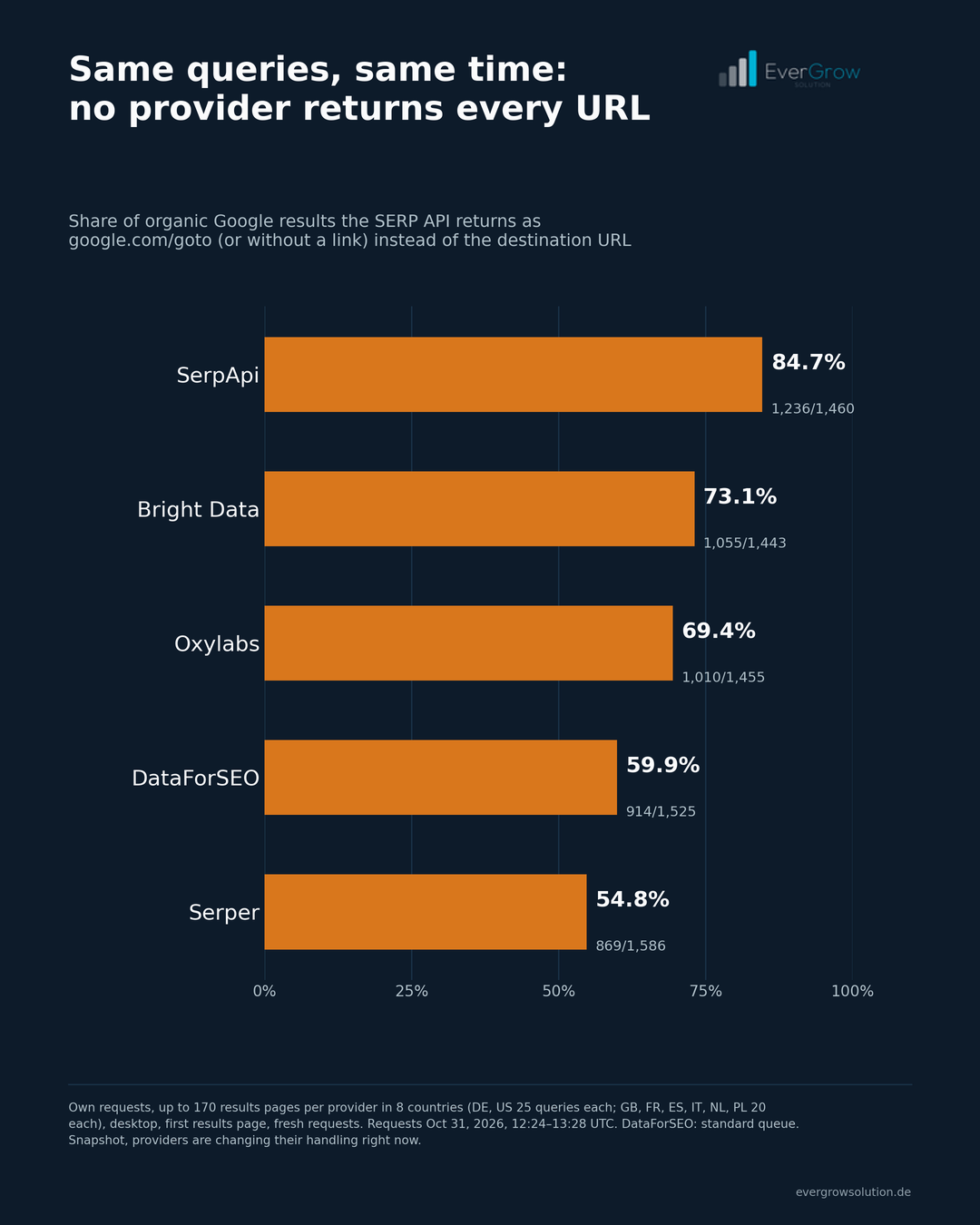
In my study of October 30, DataForSEO returned 58.7% of organic Google results as google.com/goto instead of the website’s URL. The obvious next question: is it just this provider? So on October 31 I sent the same queries at the same time to five well-known SERP APIs and analysed the raw responses the same way.
No provider returns every URL
| Provider | Results pages | Organic results | Without a real URL | Pages with at least one |
|---|---|---|---|---|
| Serper | 170 | 1,586 | 869 (54.8%) | 166 of 170 |
| DataForSEO (standard queue) | 170 | 1,525 | 914 (59.9%) | 170 of 170 |
| Oxylabs | 170 | 1,455 | 1,010 (69.4%) | 170 of 170 |
| Bright Data | 163 | 1,443 | 1,055 (73.1%) | 160 of 163 |
| SerpApi | 170 | 1,460 | 1,236 (84.7%) | 170 of 170 |
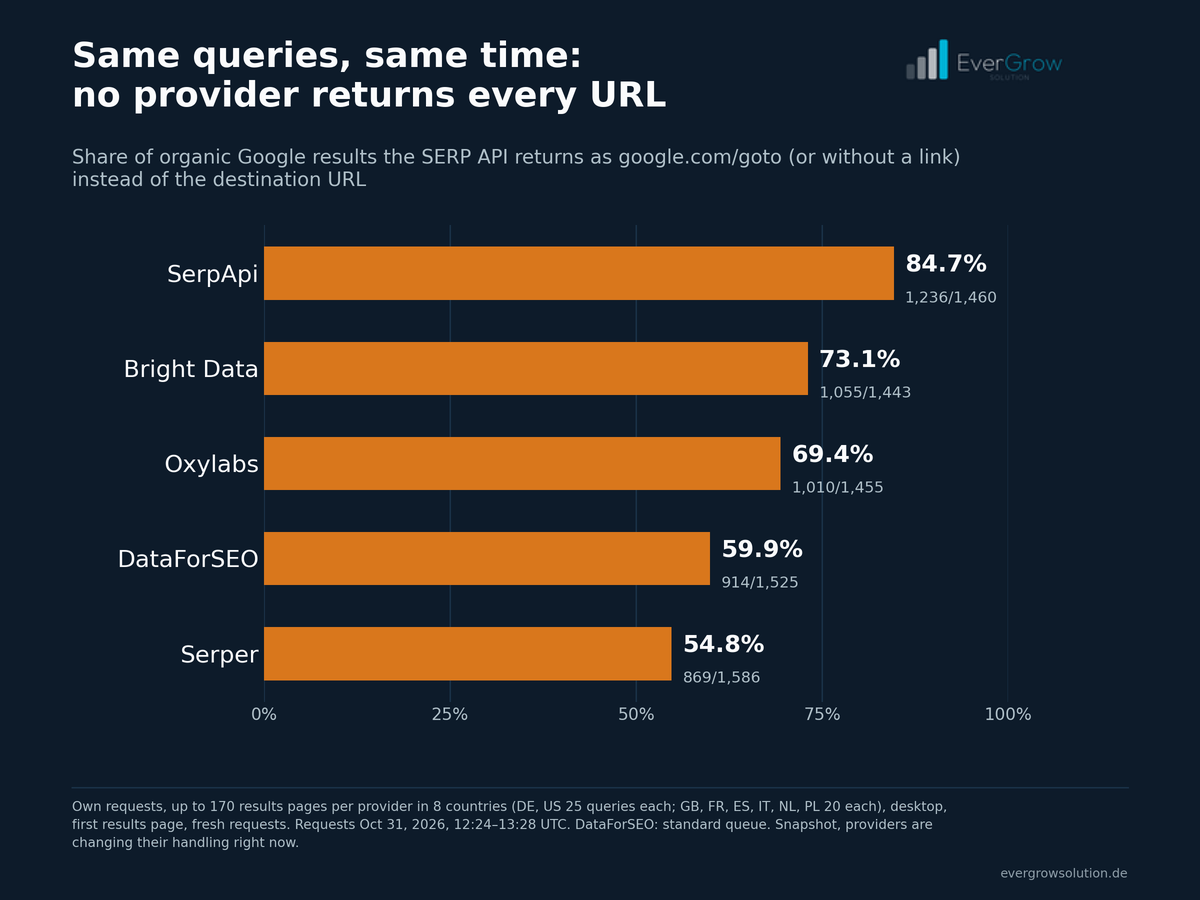
For four of the five providers, practically every results page had at least one result without a real URL. SerpApi was above 82% in all eight countries, although SerpApi announced in September that it was returning direct destination URLs again (according to PPC Land). DataForSEO’s standard queue was at 59.9%, although support had written the night before that the standard queue now resolves all links.
Complete in no country
| Provider | Germany | US | UK | France | Spain | Italy | Netherlands | Poland |
|---|---|---|---|---|---|---|---|---|
| Serper | 26.4% | 59.5% | 61.3% | 59.2% | 62.8% | 62.2% | 59.0% | 55.2% |
| DataForSEO | 57.6% | 70.0% | 63.1% | 61.4% | 53.0% | 55.7% | 58.8% | 59.4% |
| Oxylabs | 76.0% | 66.5% | 68.5% | 66.9% | 66.1% | 75.3% | 67.8% | 66.1% |
| Bright Data | 92.1% | 55.2% | 70.9% | 71.8% | 74.7% | 71.8% | 76.0% | 71.2% |
| SerpApi | 86.5% | 83.4% | 85.7% | 86.4% | 84.2% | 84.4% | 82.4% | 83.6% |
Share of organic results without a real URL. Germany and the US 25 queries each, the other countries 20 each. Different queries and languages per country, not a country comparison in the strict sense.
The range runs from 26.4% (Serper, Germany) to 92.1% (Bright Data, Germany). Notably, the same provider performs differently by country: Bright Data, for example, at 92.1% in Germany and 55.2% in the US. So a ranking of providers only holds for this mix of queries and countries.
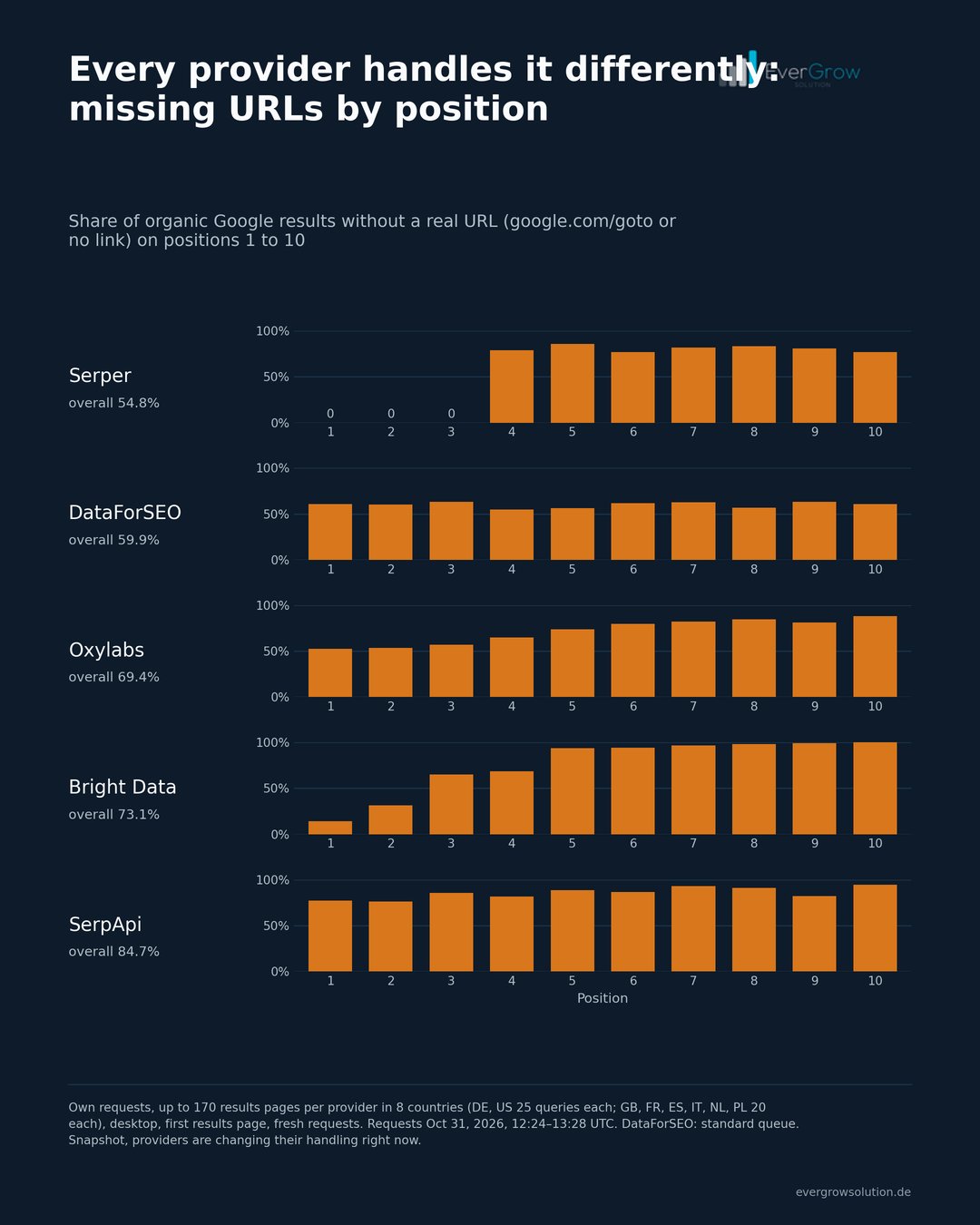
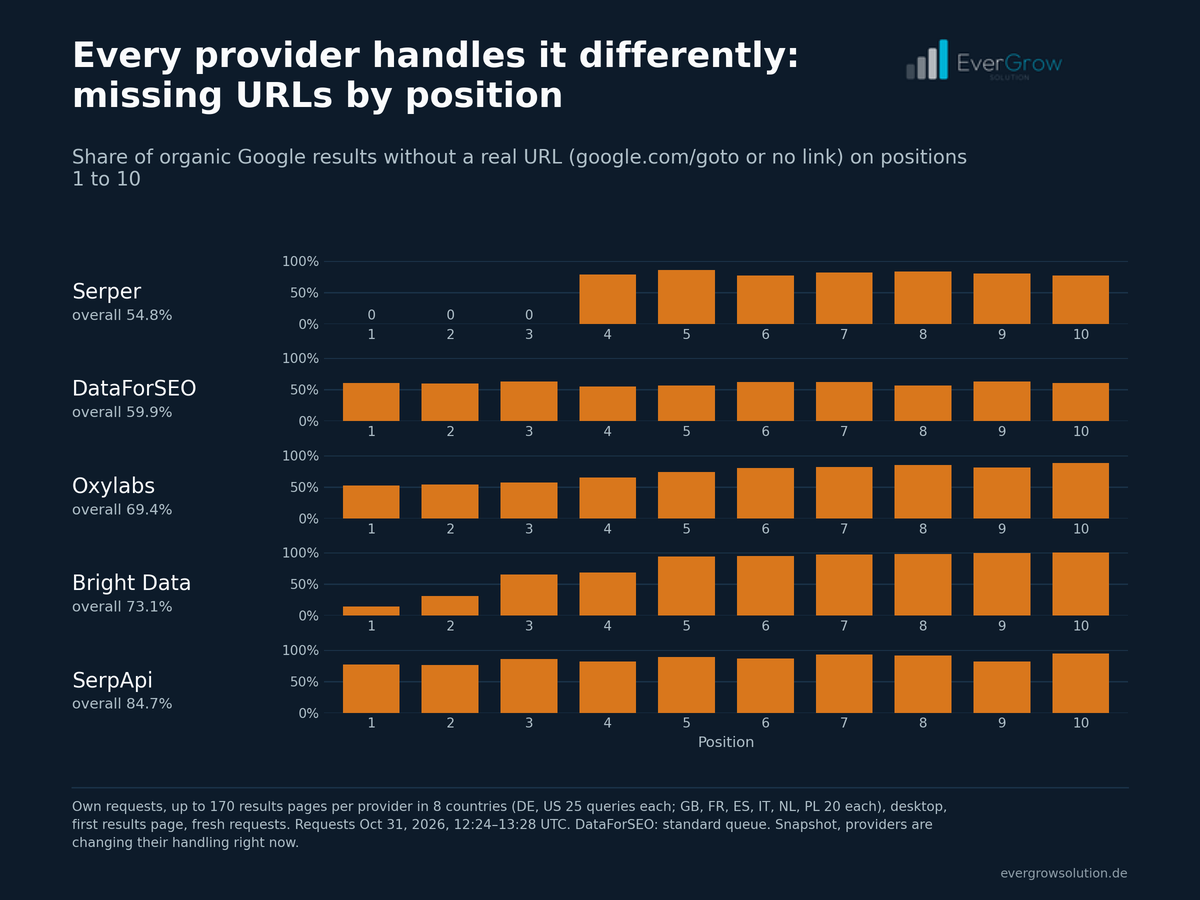
Every provider handles it differently
| Provider | Pos. 1 | Pos. 2 | Pos. 3 | Pos. 4 | Pos. 5 | Pos. 6 | Pos. 7 | Pos. 8 | Pos. 9 | Pos. 10 |
|---|---|---|---|---|---|---|---|---|---|---|
| Serper | 0% | 0% | 0% | 79% | 86% | 77% | 82% | 83% | 81% | 77% |
| DataForSEO | 61% | 60% | 63% | 55% | 57% | 62% | 63% | 57% | 63% | 61% |
| Oxylabs | 52% | 54% | 57% | 65% | 74% | 80% | 82% | 85% | 81% | 88% |
| Bright Data | 14% | 31% | 65% | 69% | 94% | 94% | 97% | 98% | 99% | 100% |
| SerpApi | 77% | 76% | 85% | 82% | 89% | 86% | 93% | 91% | 82% | 94% |
- Serper returned positions 1 to 3 with a real URL on all 170 results pages (0 of 510 without one); from position 4, about 80% came without one. It looks as if Serper resolves the top positions on purpose.
- Bright Data apparently resolves in order: 14% without a URL on position 1, over 90% from position 5.
- DataForSEO is evenly around 60% on every position.
- Oxylabs rises from 52% on position 1 to 88% on position 10; SerpApi is already at 77% on position 1.
That fits what DataForSEO says about the cause: Google limits resolving per results page, and after the first links an interstitial with a growing delay appears. Whoever resolves the top links first gets real URLs there. How the providers work internally, I can’t see from the outside.
Domain almost always readable, nobody resolves wrongly
| Provider | Field with displayed link | Domain readable for results without a URL | Form of the redirect |
|---|---|---|---|
| Serper | displayedLink | 793 of 869 (91.3%) | https://www.google.com/goto?url=… |
| DataForSEO | breadcrumb | 855 of 914 (93.5%) | https://google.com/goto?url=… |
| Oxylabs | url_shown | 1,002 of 1,010 (99.2%) | /goto?url=… (relative) |
| Bright Data | display_link | 1,025 of 1,055 (97.2%) | https://www.google.de/goto?url=… (country domain) |
| SerpApi | displayed_link | 1,180 of 1,236 (95.5%) | /goto?url=… (relative) |
- Domain readable: For 91 to 99% of results without a real URL, the domain is in the displayed link. Where it isn’t, these are mostly platform results (YouTube, Reddit, Facebook) showing views, comments or followers instead.
- Nobody resolves wrongly: All 2,287 resolved links with a displayed domain belonged to that domain (subdomains allowed, domains with umlauts compared as Punycode).
- Not only google.com/goto: SerpApi and Oxylabs return the redirect as a relative path
/goto?url=…, Bright Data with the country domain, e.g.google.de/goto. Filtering for “google.com/goto” alone misses these.
Method and limitations
- Requests: October 31, 2026, 12:24 to 13:28 UTC, all five providers in parallel, queries one after another per provider. Germany 25 local queries (services with a city), US 25 mixed queries, UK, France, Spain, Italy, the Netherlands and Poland 20 mixed queries each in the local language, the same as in the study of October 30. Desktop, first results page, fresh requests (SerpApi without cache).
- Settings: each provider’s standard Google organic request with country, language and the country’s Google domain. DataForSEO via the standard queue (all tasks posted at the start), Bright Data via a SERP API zone with parsed JSON, Oxylabs via the Web API (google/search). I did not test providers’ additional options.
- Counted: organic results whose link is a Google redirect (
google.*/goto?url=, including relative) or missing. “Domain readable”: the displayed link contains a real domain; text like “30.3K+ followers” doesn’t count. Analysed from the stored raw responses, with manual spot checks per provider and country. - Failures: Bright Data returned no usable response for 7 of 170 requests, even after retrying. Part of the Poland and Bright Data requests ran about 40 minutes later (13:13 to 13:28 UTC) because of a bug in my script.
- Scope: I only measured whether organic results come with a real URL. Price, response time, reliability and coverage of other result types are not part of this study.
- Limitations: a snapshot of one afternoon, desktop only, hand-picked queries. Results on the same page are not independent, so I give no confidence intervals. Providers are changing their handling right now; results may look different in a week. One more provider (cloro) is not included because its terms of service exclude benchmarking. I have no business relationship with any of the providers beyond a regular customer account.
Strength of evidence
| Statement | Strength of evidence |
|---|---|
| No provider returns every URL, in none of the eight countries | shown for this comparison (snapshot) |
| Order Serper, DataForSEO, Oxylabs, Bright Data, SerpApi | holds for this mix of queries and countries, partly different per country |
| Pattern by position (Serper positions 1 to 3, Bright Data in order) | shown as a pattern; how providers resolve internally can’t be checked |
| Resolved links belong to the displayed domain | shown (2,287 of 2,287) |
| Cause: Google limits resolving per results page | DataForSEO’s statement, fits the pattern, not fully verifiable from the outside |
What does this mean for you?
- Switching providers doesn’t solve it. Even the best provider in the comparison returned about half of the results without a real URL.
- Read the domain from the displayed link. The field names are in the table above. For platform results without a domain, the platform name helps.
- Look for every form of the redirect: google.com/goto, relative /goto?url= and country domains like google.de/goto.
- Get the full URL from a converter when you need it. DataForSEO offers a free endpoint for this (
appendix/goto_url_converter), which returned the correct domain for all links in my tests. - Ask your rank tracker which API it uses and how it assigns results without a URL. Rankings matched only by domain may be too low since late October.
Sources
- My own study: Google goto links in SERP API data – 59% of results without the target domain, October 31, 2026 (including DataForSEO support’s statements on the cause).
- Luis Rijo: SerpApi restores direct URLs after Google goto redirect rollout, PPC Land, September 6, 2026. https://ppc.land/serpapi-restores-direct-urls-after-google-goto-redirect-rollout/
- DataForSEO: Google’s Goto Rollout: We Already Resolve 99.99% of URLs, August 27, 2026. https://dataforseo.com/update/googles-goto-rollout-we-already-resolve-99-99-of-urls
- cloro: Terms of Service, section 2.3(e), last updated July 19, 2026. https://cloro.dev/terms/
- Public sources accessed on October 30 and 31, 2026.